
Every joint in your body has a natural range of motion — the distance and direction it can move comfortably.
That’s why you can bend your elbow but not your knee backward, or rotate your shoulder in a circle but not your hip.
Each joint is designed with limits that support your daily movements.
But when your typical range of motion becomes restricted, due to injury, aging, or certain medical conditions, everyday tasks can become uncomfortable or even painful.
Limited range of motion can affect your flexibility, increase your risk of injury, and make it harder to stay active.
The good news?
Physical therapy can help.
In this article, we’ll explore:
- What limited range of motion is and how it feels
- Common causes, including arthritis, neurological conditions, and injuries
- How physical therapy can help restore mobility and reduce discomfort
If you’ve been feeling stiff or less mobile than usual, this guide is for you.
Let’s take a closer look at what might be going on and how to start moving more freely again.
What Is A Limited Range Of Motion?
Each of your joints have a typical range of motion in which they can flex, bend, and extend.
This range of mobility also helps determine if a joint is functioning as it should.
Limited range of motion occurs when you have reduced range of motion in any of your joints.
Limited range of motion can cause:
- Difficulty bending, extending, or rotating your joint
- Tight, painful, or restricted movement
- Difficulty completing daily activities
- Increased risk of injury
It’s normal for your range of motion to decline as you get older.
However, there are also numerous conditions that can contribute to its development.
Whatever the cause, physical therapy can help you manage your symptoms and improve and maintain your joints’ flexibility.
What Causes A Limited Range Of Motion?
There are several factors that can cause a limited range of motion.
It can be the result of things like muscular imbalances, joint abnormalities, injuries, poor posture, pain, neurological conditions, and other medical conditions.
The joint or joints affected and the severity of how restricted your mobility is depends on the specific cause.
Let’s look at some common conditions that are associated with a limited range of motion and how physical therapy can help.
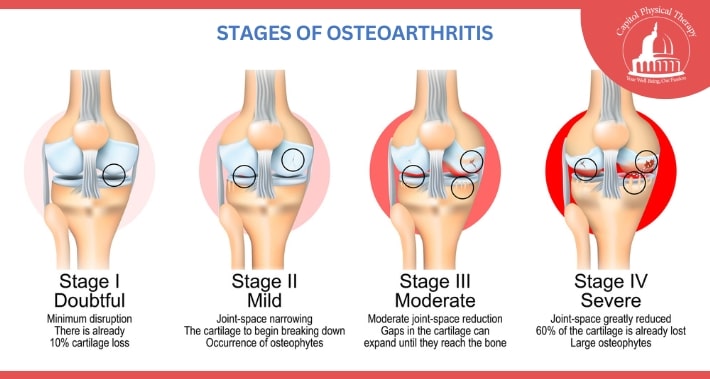
1. Osteoarthritis
Osteoarthritis is the most common form of arthritis, which refers to inflammation of the joints.
It can occur in any joint, but it’s most common in:
With osteoarthritis, the protective layer in your joint that separates two bones wears down.
As result, the bones rub together and cause the joint to become irritated, which can lead to numerous symptoms, including:
- Chronic pain
- Stiffness
- Tenderness
- Inflammation
Osteoarthritis is a degenerative disease, meaning that it gets worse over time.
It’s mainly caused by damage to the joint, resulting from things like ligament injuries, torn cartilage, dislocated joints, or accumulated damage.
Aging is also a common factor that leads to the development of osteoarthritis, alongside other risk factors, such as:
- Obesity
- Genetics
- Gender (women are more susceptible)
- Poor posture
The good news is that physical therapy can help manage your osteoarthritis symptoms and slow down its progression.
A physical therapist will create a tailored treatment plan based on the severity and location of your symptoms.
They’ll help you understand how to reduce certain risk factors, and help implement lifestyle changes alongside physical therapy.
They can also implement an exercise plan that can strengthen and support your joints and restore mobility.
Combining physical therapy with lifestyle changes provides you with the best chance to manage and mitigate your symptoms.
RELATED ARTICLE: Physical Therapy Treatments For Osteoarthritis
2. Rheumatoid Arthritis
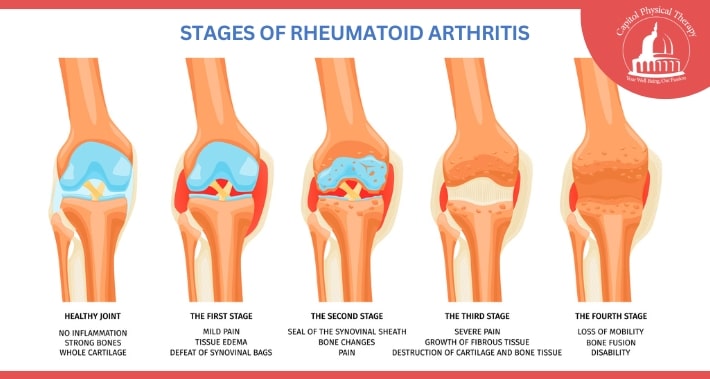
Rheumatoid arthritis is an autoimmune disease that causes chronic inflammation of the joints.
An autoimmune disease occurs when your body’s immune system mistakenly attacks its own tissues.
In rheumatoid arthritis, your body’s immune system targets and attacks the soft tissue around your joints.
This causes fluids to build up around the affected tissue and can lead to:
- Inflammation
- Stiffness
- Pain
- Chronic fatigue
- Reduced range of motion
Symptoms can sometimes flare up for a period of time and then disappear for a period before returning.
But why this happens, it’s still unclear.
However, certain risk factors that can contribute to its development include:
- Excessive alcohol consumption
- Smoking
- Genetics and family history
- Aging
- Obesity
- Hormonal imbalances
- Adrenal issues
Physical therapy can help you manage your rheumatoid arthritis symptoms and improve your daily mobility.
Physical therapy approaches and treatment goals will be tailored to meet your needs depending on your symptoms and challenges.
Oftentimes this includes advice on improving general fitness, exercise plans, energy saving strategies, and pain management.
If you have rheumatoid arthritis and it’s causing you limited range of motion, speak to a physical therapist today.
RELATED ARTICLE: Physical Therapy Treatments For Rheumatoid Arthritis
3. Parkinson’s Disease
Parkinson’s disease is a degenerative disease that affects your nervous system and the parts of your body that it controls.
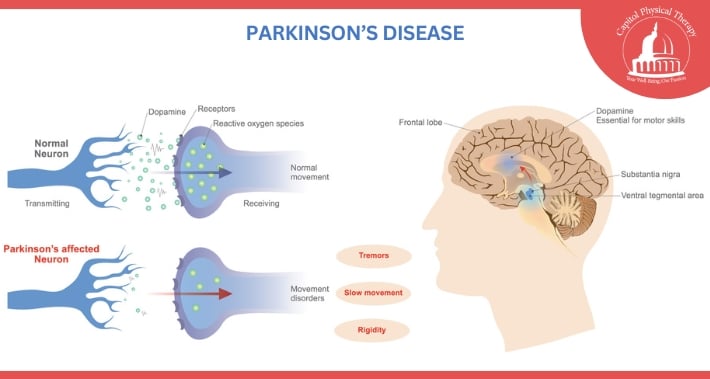
It can create a chemical imbalance due to the loss of dopamine producing nerve cells.
This can affect several bodily functions, including cognitive processing, physical mobility, and mood regulation.
Tremors or reduced and slowed movements are typical physical symptoms of Parkinson’s disease.
However, there are numerous other symptoms, which vary in relation to the severity of the disease.
Symptoms of Parkinson’s disease can include:
- Decreased sense of smell
- Lightheadedness when standing
- Sleep related issues
- Tremors
- Reduced movement
- Chronic pain in your neck
- Chronic pain in your shoulders
- Chronic pain in your lower back
- Poor balance
- Muscle stiffness
- Slowed movements
- Poor posture
- Difficulty making facial expressions
- Difficulty controlling speech volume
Parkinson’s disease can also cause bursitis, a condition that causes inflammation in fluid filled sacs within the joints.
RELATED ARTICLE: Physical Therapy for Knee Bursitis
RELATED ARTICLE: Physical Therapy for Hip Bursitis
This can further cause pain and a limited range of motion.
Parkinson’s disease is the result of issues with a part of your brain known as the substantia nigra.
In this area of your brain there are dopamine producing nerve cells, which the disease breaks down and kills.
This hormonal imbalance caused by the reduction in dopamine then affects your bodily functions and mobility.
There isn’t a specific known reason why this happens, but some potential risk factors can include:
- Exposure to environmental toxins
- Gender (men are twice as likely to have Parkinson’s disease)
- Aging
- Family history of the disease
However, you can get Parkinson’s disease without any of the above factors.
Famously, actor Michael J. Fox was diagnosed with Parkinson’s disease at just 30 years old.
While there are no known cures, physical therapy can help manage Parkinson’s disease symptoms and slow down its rate of progression.
A physical therapist will conduct a comprehensive evaluation of your physical functions and capabilities.
Then they’ll put together a treatment plan that focuses on keeping you as mobile and active as possible.
Treatments focus on aspects such as:
- Pain management
- Fall prevention strategies
- Physical wellness programs
- Fine motor skills
- Gait training
If you have Parkinson’s disease, the sooner you begin physical therapy the better chances to maintain your quality of life for longer.
RELATED ARTICLE: Physical Therapy Treatments For Parkinson’s Disease
4. Other Possible Causes
There are several other potential causes that are associated with limited range of motion.
Some additionally causes of limited range of motion in the joints can include:
- Cerebral palsy
- Sepsis
- Congenital torticollis
- Syphilis
- Ankylosing spondylitis
- Legg-Calve-Perthes disease
- Joint dislocations
- Fractures
- Muscle stiffness
- Inflammation of the joint or tissue
- Chronic pain
Whatever the cause, if you experience any reductions in the normal range of motion of your joints, it’s a good idea to speak to a physical therapist.

How Can Physical Therapy Help With Your Limited Range Of Motion?
If you experience or have been diagnosed with a condition that’s causing you limited range of motion, physical therapy can help.
If you notice that you have reduced range of motion in any of your joints, speak to a physical therapist as soon as possible.
Starting physical therapy right away can help manage your condition ahead of time and slow down its progression.
Physical therapy treatment will depend on the severity of your symptoms, their location, and the underlying cause.
The goal of physical therapy for a limited range of motion is to help manage symptoms, control its progression, and improve joint flexibility and overall mobility.
Your physical therapist will put together a tailored treatment plan that addresses your challenges and meets your goals.
Physical therapy for a limited range of motion can include:
- Providing advice and encouragement on improving fitness levels
- Creating a personalized exercise plan to improve joint mobility and muscle strength
- Stretching techniques to relieve tension
- Hands on joint mobilization techniques
- Advice on lifestyle changes
- Pain management strategies
- Fine and gross motor skills therapy
- Posture and balance therapy
- Improved sleep strategies
A physical therapist will focus on strategies to reduce pain and improve joint mobility and movement.
Remember that physical therapy extends to the home as well.
Implementing lifestyle changes, such as exercise, to reduce risk factors and support your physical wellness is key.
While limited range of motion can be caused by degenerative conditions, physical therapy can help you mitigate your symptoms and remain active for as long as possible.
Book Your Appointment With Our Physical Therapy Clinic Today
Limited range of motion can affect everything from daily activities to long-term mobility — but with the right care, you don’t have to let it hold you back.
Physical therapy can help reduce stiffness, improve flexibility, and restore your ability to move comfortably.
At Capitol Physical Therapy, we create customized treatment plans designed to meet you where you are and help you move forward with confidence.
Whether you’re managing a chronic condition or recovering from an injury, we’re here to support your goals.
Book your appointment with Capitol Physical Therapy today and take the first step toward moving freely again.
1100 H St NW Suite 1100,
Washington, DC 20005
- https://g.page/capitolptdc
9560 Pennsylvania Ave. # 202,
Upper Marlboro, MD 20772
- https://goo.gl/maps/zjL4NnnuThRhrcS86
Capitol Physical Therapy offers orthopedic and other pain related solutions, with our versitile team of physical therapists in Washington, DC and Upper Marlboro, MD