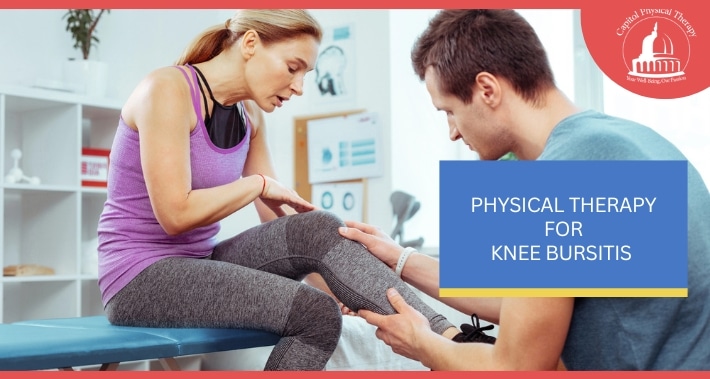
Your knees provide a vital service for your body.
They support your weight and provide stability as you do things like walking, climbing, and kneeling.
So, as you might imagine, developing any type of knee related condition can significantly interfere with your daily life.
What can you do to help manage the symptoms of knee bursitis and prevent future knee conditions?
Physical therapists play an important role in joint health and symptom management.
At Capitol Physical Therapy, we offer physical therapy for knee bursitis for people looking for ways to manage their already existing condition.
However, we also firmly believe in the power of knowledge, and that patient education can help lower your chances of developing knee bursitis in the first place.
Therefore, the purpose of this article is twofold:
First, we’ll explain exactly what knee bursitis is, as well as explore its potential causes.
Then, we’ll discover the various ways physical therapy for bursitis in the knee can help.
What Is Knee Bursitis?
Your knee is the largest joint in your body.
It sits between and connects your thigh bone and your femur with the rest of your leg (tibia and fibula).
Some people think that their knee is a single component; however, it actually has three distinct parts: the patellofemoral joint, the tibiofemoral joint, and the tibiofibular joint.
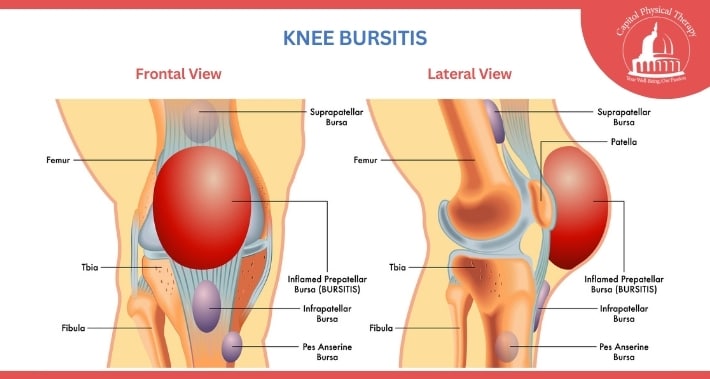
Several different bursae surround it.
These fluid-filled sacs help lessen the friction between your bones, tendons, and skin.
11 different bursae help support your knee.
They include:
- The suprapatellar bursae, located between your femur and quadriceps
- The prepatellar bursa, located at the top of your knee
- The infrapatellar bursa, located below your knee
- The anserine bursa, located inside your knee between the hamstring muscle and lower leg
People with knee bursitis develop inflammation in one or more of these bursae.
This condition is especially common amongst athletes, particularly runners.
You can develop bursitis in other areas of your body as well.
In particular, our clinic frequently provides physical therapy for bursitis in the hips, elbow, and shoulder as well.
Knee Bursitis Causes
Knee bursitis can develop either gradually, such as from chronic pressure or stress, or suddenly after certain injuries, such as a knee injury.
Gradual development of knee bursitis typically involves repetitive stress injuries.
For instance, this type of gradual development is common with people who work in periods of prolonged kneeling.
This includes cleaners, tilers, and flooring installation contractors.
Over time, kneeling positions can cause repeated irritation to your bursae.
Repetitive stress from activities such as running may also cause this irritation.
Such irritation causes thickening around your bursae, which ultimately leads to bursitis.
Arthritis can lead to bursitis in your knees as well.
This is true of osteoarthritis, rheumatoid arthritis, and other types as well.
Rapid development of knee bursitis most commonly occurs following physical knee trauma.
For instance, hitting your knee too hard, such as during a car accident, can cause bleeding in the sacs surrounding your bursae, as well as subsequent thickening around your bursae.
This is one of the many reasons why physical therapy after a car accident is so important.
Certain surgeries, such as knee replacement surgery, may also cause rapid development of knee bursitis.
This is one of the ways a physical therapist can help you recover from a knee replacement.
What Does Knee Bursitis Feel Like?
Knee bursitis can feel different for everyone.
Most people report feeling varying degrees of pain and swelling.
This pain typically worsens when performing activities that stress the bursae, including kneeling, jumping, and running.
RELATED ARTICLE: Health Benefits Of Running
Subsequently, many people with knee bursitis also experience limited mobility in their legs.
You may have difficulty sitting down and standing up, as well as kneeling or squatting.
Some people report an improvement in pain after periods of rest, whereas others continuously feel pain even while at rest.
Your knee pain may also worsen when you apply pressure to the front of your knee.
You may also experience knee stiffness.
This stiffness can make it difficult to straighten and bend your knee.
Finally, you may also notice certain visual symptoms, such as swelling and redness in the front of your knee.
Role Of Physical Therapy In Treating Knee Bursitis
Your physical therapist will play an important role in knee bursitis recovery.
For instance, your physical therapist can show you how to perform knee pain relief exercises as well as exercises to reduce knee swelling.
They can also help manage symptoms such as knee stiffness and reduced range of motion.
A physical therapist can help with your recovery as early as a few hours after your injury.
During the first 24 to 48 hours, your physical therapist will primarily focus on symptom management.
For instance, we can provide gentile mobilizations, passive stretching and mobility, light knee compressions, icing techniques, as well as instruct you on the best ways to rest your knee.
After this initial period, we’ll create a personalized treatment plan that focuses on active mobility, stretching and strengthening exercises.
The goal of this is to target knee inflammation and other symptoms.
Let’s take a closer look at these techniques.
1. Knee Pain Relief Exercises
Your physical therapist will provide you with exercises that target your symptoms and improve the overall strength of your knee.
We can help you discover ways to modify and safely perform the activities that might have contributed to your bursitis in the first place.
We’ll also work on stretching and strengthening exercises that’ll help with pain management.
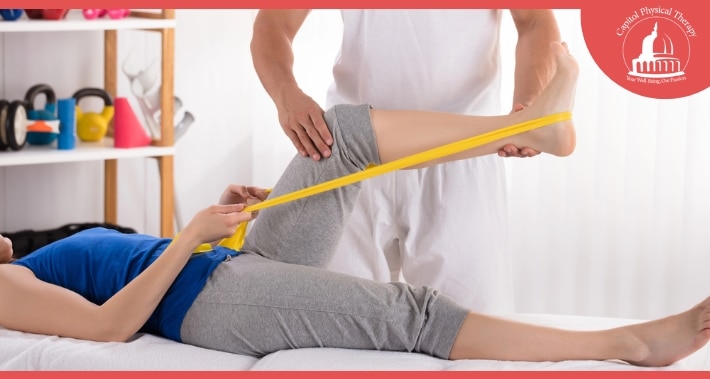
Stretching exercises for knee bursitis typically begins with passive movements.
During passive stretching exercises, your physical therapist will gently move your leg in ways that promote better range of motion.
This process can also help your physical therapist locate and correct any tightened leg muscles.
Over time, you’ll be able to perform these stretches on your own.
Strengthening exercises are of equal importance.
Your physical therapist will target any weakened or injured leg muscles and show you exercises that help improve them.
Over time, these exercises can help you improve your leg strength as well as endurance.
2. Exercises To Reduce Knee Swelling
Your physical therapist can also help you manage your knee swelling symptoms.
Physical therapists don’t focus only on exercises.
We can also provide you with aids that will help lessen inflammation and promote recovery.
Physical therapy for knee bursitis often involves both ice and compression techniques, as well as elevation and rest techniques.
Ice is an important tool for inflammation reduction.
For instance, we can show you how to apply ice packs to your legs to help reduce warmth and inflammation in your knee.
RELATED ARTICLE: Understanding Heat And Cold Therapy
We can also provide you with compression wraps or knee sleeves that will help reduce your swelling.
Elevation and rest techniques can also help reduce any inflammation.
As with any leg injury, elevation is of the utmost importance.
Elevation involves raising your knee with the help of a few pillows.
This process helps promote inflammation reduction in your knee.
Finally, getting enough rest can do wonders for recovery.
Your physical therapist will likely advise you to take a break from the activities that contributed to your condition.
Additionally, we typically recommend that you refrain from kneeling or performing other activities that worsen your pain, at least until you’re fully recovered.
Book Your Appointment With Our Physical Therapy Clinic Today
Knee bursitis can interfere with even the simplest of movements, but with the right care, healing is absolutely possible.
At Capitol Physical Therapy, we provide personalized treatment plans to reduce pain, improve mobility, and prevent future flare-ups.
Whether you’re recovering from an injury, managing arthritis, or dealing with repetitive strain, we’re here to guide your recovery.
Our experienced physical therapists are ready to support you with compassionate, evidence-based care.
Book your appointment with Capitol Physical Therapy today and take the next step toward lasting knee relief.
1100 H St NW Suite 1100,
Washington, DC 20005
- https://g.page/capitolptdc
9560 Pennsylvania Ave. # 202,
Upper Marlboro, MD 20772
- https://goo.gl/maps/zjL4NnnuThRhrcS86
Capitol Physical Therapy offers orthopedic and other pain related solutions, with our versitile team of physical therapists in Washington, DC and Upper Marlboro, MD