When most people think of arthritis, they picture stiff, aching joints that only affect older adults.
While it’s true that some forms of arthritis become more common with age, arthritis isn’t a single condition — and it certainly isn’t limited to seniors.
In fact, there are more than 100 different types of arthritis, many of which can affect younger adults and even children.
Because there are so many misconceptions surrounding arthritis, it can be difficult to know what’s fact and what’s fiction.
Questions like “What exactly is arthritis?”, “What are the different types?”, and “Can physical therapy really help?” are some of the ones we hear most often.
In this article, we’ll answer some of the most frequently asked questions about arthritis, including:
- What arthritis is and the different forms it can take
- Who can develop arthritis and the symptoms to watch for
- Common myths, like whether cracking your knuckles causes arthritis
- And how physical therapy can help reduce pain, improve mobility, and keep you active
Whether you’ve recently been diagnosed or are simply trying to better understand your joint pain, this guide will help you separate myth from fact and better understand your treatment options.
Because arthritis often affects joints, muscles, movement, and daily function, it can also overlap with many conditions treated through orthopedic physical therapy.
What Is Arthritis?
Arthritis is an umbrella term for more than 100 conditions that affect the joints, tissues around the joints, and other connective tissues.
The word itself means “joint inflammation.”
Many types of arthritis are chronic, meaning symptoms may last for months or years and require ongoing management.
However, symptoms can often be improved with the right treatment plan.
Are There Different Types Of Arthritis?
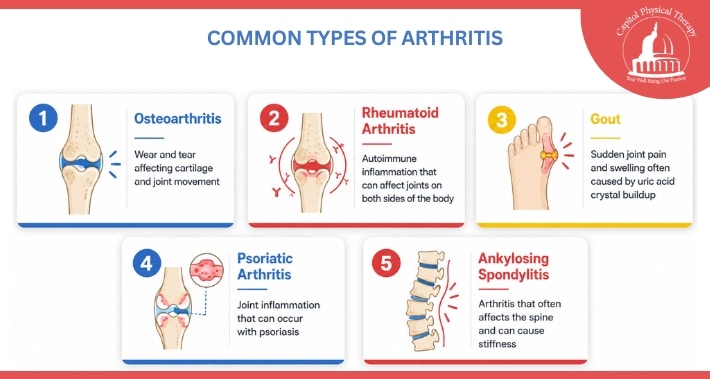
There are many different types of arthritis.
Let’s have a look at some of the most common ones below.
Osteoarthritis
Osteoarthritis is the most common type of arthritis.
And it’s not to be confused with osteoporosis, a disease characterized by decreased bone mass.
While it can affect people of any age, it most commonly affects older adults, and is a leading cause of age-related disability.
Because osteoarthritis is more common with age, some people also benefit from seniors’ health physical therapy, especially if joint pain is affecting balance, strength, or independence.
For older adults dealing with weakness or reduced resilience, it may also help to learn more about how physical therapy can support frailty.
Osteoarthritis occurs when the tissues within a joint gradually break down over time.
Cartilage is one of the key tissues affected.
As cartilage becomes damaged or worn down, the joint may not move as smoothly, which can contribute to pain, stiffness, and reduced mobility.
Osteoarthritis can occur in any joint, and it commonly affects the hands and wrists, knees, hips, and spine.
In the spine, arthritis may contribute to stiffness or discomfort in the upper back, lower back, or neck, which may overlap with other spinal issues.
Symptoms can include pain, tenderness, stiffness, and inflammation.
For some people, arthritis can also contribute to limited range of motion, making it harder to bend, reach, grip, walk, or move comfortably.
Physical therapy for osteoarthritis focuses on pain management, improving mobility, and helping reduce the impact of joint-related limitations on daily life.

Rheumatoid Arthritis
Rheumatoid arthritis is a chronic autoimmune disease that primarily affects the joints.
An autoimmune condition occurs when your body’s immune system mistakenly attacks healthy tissue instead of only targeting potential threats or infections.
In rheumatoid arthritis, the immune system attacks joint tissues, leading to inflammation, pain, swelling, stiffness, and loss of function.
When inflammation begins to interfere with daily movement, physical therapy may help improve mobility and reduce inflammation-related limitations.
Over time, ongoing inflammation can contribute to pain, stiffness, reduced mobility, and joint damage.
Rheumatoid arthritis can occur at any age, though it often begins in middle age.
The symptoms of rheumatoid arthritis can include:
- Stiff joints, often worse first thing in the mornings
- Painful, swollen joints on both sides of your body
- Chronic fatigue
- General discomfort
- Low-grade fever
- Loss of joint function or range of movement
- Redness, warmth, and tenderness in your joints
Rheumatoid arthritis is said to “flare”, meaning you can experience periods of more intense or worsening symptoms.
Or, it can be in “remission”, meaning you experience periods of little or no symptoms.
While there is no known cause for rheumatoid arthritis, several factors have been identified that may increase your risk of developing it.
These factors can include age, family history, smoking, excess weight, and certain environmental exposures.
Women are more likely to be diagnosed with rheumatoid arthritis, but it can affect people of all genders.
If you are concerned that you may have rheumatoid arthritis, it’s a good idea to speak to your doctor.
They can refer you to a rheumatologist for a diagnosis if necessary.
Whether or not you have a diagnosis, physical therapy for rheumatoid arthritis can help manage your pain and keep you able to perform your daily tasks.
Other Types Of Arthritis
In addition to the more common types of arthritis discussed above, there are many others.
These can include:
- Ankylosing spondylitis
- Gout
- Pseudogout
- Psoriatic arthritis
- Reactive arthritis
These conditions can vary widely in severity and may require different approaches to treatment and management, which is why an accurate diagnosis is important.
Who Can Get Arthritis?
People of any age can develop arthritis, including children.
However, certain types, especially osteoarthritis, become more common with age.
When arthritis affects strength, balance, or walking confidence, fall prevention physical therapy may be helpful, especially for older adults who feel less steady on their feet.
As mentioned above, rheumatoid arthritis affects more women than men, but it still affects a wide range of people of any gender.
If you are concerned you may have arthritis symptoms, it’s always a good idea to speak to your healthcare provider.
How Do You Know If You Have Arthritis?
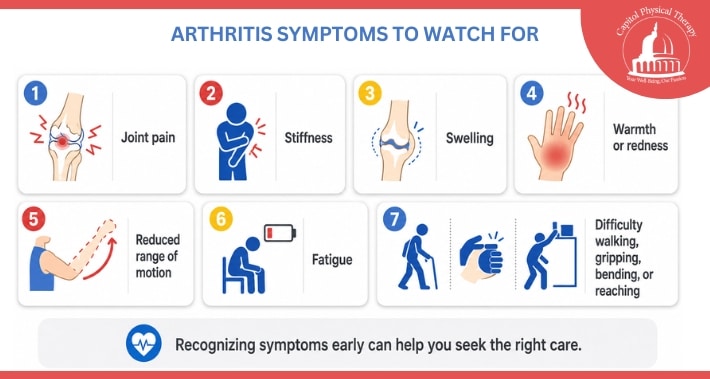
Joint pain, stiffness, swelling, and fatigue are all common arthritis symptoms.
However, those symptoms alone are not sufficient to determine if you have arthritis.
A healthcare provider can evaluate your symptoms, review your health history, perform a physical exam, and order imaging or lab tests when needed.
Your doctor may also refer you to a specialist for further testing or investigations.
Even before or after a formal diagnosis, physical therapy can help address movement limitations, weakness, stiffness, and pain that interfere with daily function.
Does Cracking Your Knuckles Cause Arthritis?
There’s no evidence to indicate that cracking your knuckles directly leads to developing arthritis.
However, if cracking is painful, forceful, or associated with swelling, stiffness, or reduced function, it’s worth discussing with a healthcare provider.
Joint pain, swelling, or loss of function may point to another issue that should be evaluated.
When Should You See A Doctor For Arthritis Symptoms?
It’s a good idea to speak with a healthcare provider if joint pain, swelling, stiffness, or reduced mobility lasts more than a few days, keeps coming back, or begins interfering with your daily activities.
You should also seek medical guidance if you notice redness, warmth, significant swelling, fever, unexplained fatigue, or symptoms that affect multiple joints.
Getting an accurate diagnosis can help determine what type of arthritis or joint condition may be involved and what treatment options are most appropriate.
How Can A Physical Therapist Help With Arthritis?
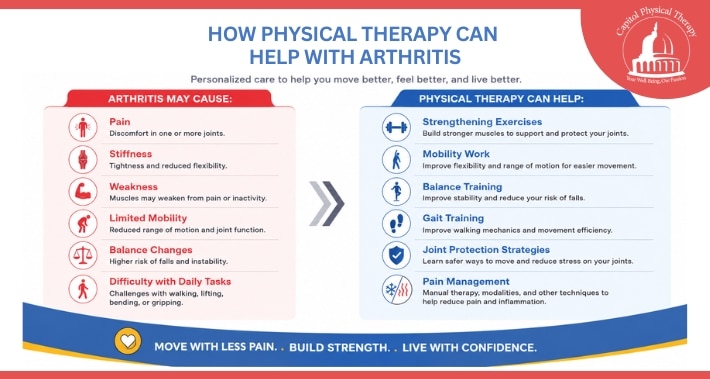
A physical therapist can create an individualized exercise program for you.
They can also help you build safer movement habits, improve strength and flexibility, and identify strategies that reduce stress on painful joints.
Your physical therapist may perform a thorough evaluation to understand your symptoms, movement limitations, strength, flexibility, balance, and the activities that are most difficult for you.
From there, they can design an individualized program based on your specific needs, goals, and tolerance level.
If arthritis is affecting the way you walk, gait training may also help improve movement efficiency, reduce compensation patterns, and support safer daily mobility.
This may include aerobic exercise, strengthening, stretching, balance work, manual therapy, and education on joint protection strategies.
For some patients, neuromuscular reeducation may also be used to improve coordination, movement control, and how the body responds to joint pain or stiffness.
Your physical therapist may also recommend heat and cold therapy to help relieve your pain.
When appropriate, dry needling may also help manage muscle tension or pain that occurs alongside arthritis.
For some patients, it may be considered as part of a broader non-opioid pain management plan.
Take The Next Step Toward Healthier Joints
Arthritis symptoms can be frustrating, but they don’t have to keep you from living an active, fulfilling life.
With the right treatment plan, you can work toward reducing pain, improving joint mobility, maintaining independence, and continuing the activities you enjoy.
At Capitol Physical Therapy, our team develops personalized treatment plans to help you manage your symptoms, protect your joints, and move with greater confidence.
With two convenient locations in the DC area, expert care is always within reach.
Book your appointment with Capitol Physical Therapy today and take the next step toward healthier joints and better movement.
1100 H St NW Suite 1100,
Washington, DC 20005
- https://g.page/capitolptdc
9560 Pennsylvania Ave. # 202,
Upper Marlboro, MD 20772
- https://goo.gl/maps/zjL4NnnuThRhrcS86
Capitol Physical Therapy offers orthopedic and other pain related solutions, with our versitile team of physical therapists in Washington, DC and Upper Marlboro, MD