Are you noticing pain when you chew, yawn, or open your mouth?
Does your jaw feel stiff, lock up, or make clicking sounds that are starting to concern you?
These symptoms can sometimes point to a problem with your temporomandibular joint, also known as the TMJ.
For a broader overview of jaw pain, clicking, locking, and treatment options, you can also read our guide to TMJ disorders and physical therapy.
In some cases, arthritis may be one of the factors contributing to your jaw pain.
If you’re still learning about arthritis more generally, our arthritis FAQ guide explains common types, symptoms, myths, and physical therapy treatment options.
Your TMJ is one of the most frequently used joints in your body.
It helps you eat, speak, smile, and move your jaw throughout the day.
So when this joint becomes irritated, inflamed, or affected by arthritis, everyday activities like chewing, speaking, and yawning can become uncomfortable.
The good news is that many TMJ disorders respond well to conservative treatment.
For patients dealing with jaw pain, clicking, stiffness, or difficulty opening your mouth, TMJ pain physical therapy can help address the joint, surrounding muscles, posture, and movement patterns that may be contributing to symptoms.
Physical therapy can help reduce pain, improve jaw movement, ease tension in the surrounding muscles, and address contributing factors like posture, jaw clenching, or neck stiffness.
If jaw pain has become persistent or is affecting your quality of life, physical therapy for pain management may help you find safer, movement-focused ways to reduce discomfort.
In this article, we’ll take a closer look at:
- What TMJ disorders are
- How arthritis can affect the jaw joint
- Common symptoms of arthritis-related TMJ pain
- How TMJ disorders are evaluated
- And how physical therapy can help you find relief
Let’s explore the connection between TMJ disorders and arthritis — and what you can do to start moving, chewing, and speaking more comfortably again.
What Is A TMJ Disorder?
TMJ stands for temporomandibular joint, and you have one on each side of your jaw.
These joints act like sliding hinges that connect your jawbone to your skull.
A TMJ disorder occurs when there is a disruption in how your TMJ joints or their surrounding muscles work.
Some conditions affect the joint itself; others affect the muscles used for chewing, and some cause headaches due to jaw problems.
TMJ disorder symptoms may include:
- Pain in one or both jaw joints
- Pain around the ears
- Pain when chewing
- Aching pain in the face, neck, or eyes
- Difficulty opening or closing your mouth comfortably
Some people may also have difficulty opening or closing their mouth if the joint locks or catches.
While occasional clicking or popping sounds in your jaw can be common, you should pay attention if the clicking becomes painful.
The exact cause of a TMJ disorder isn’t always clear.
Several factors can contribute to it, such as jaw injuries, teeth grinding, jaw clenching, and stress.
For some people, TMJ symptoms improve over time, while others may experience persistent or recurring symptoms that require treatment.
What Is The Connection Between Arthritis and TMJ Disorders?
Arthritis and TMJ disorders are more connected than you might think.
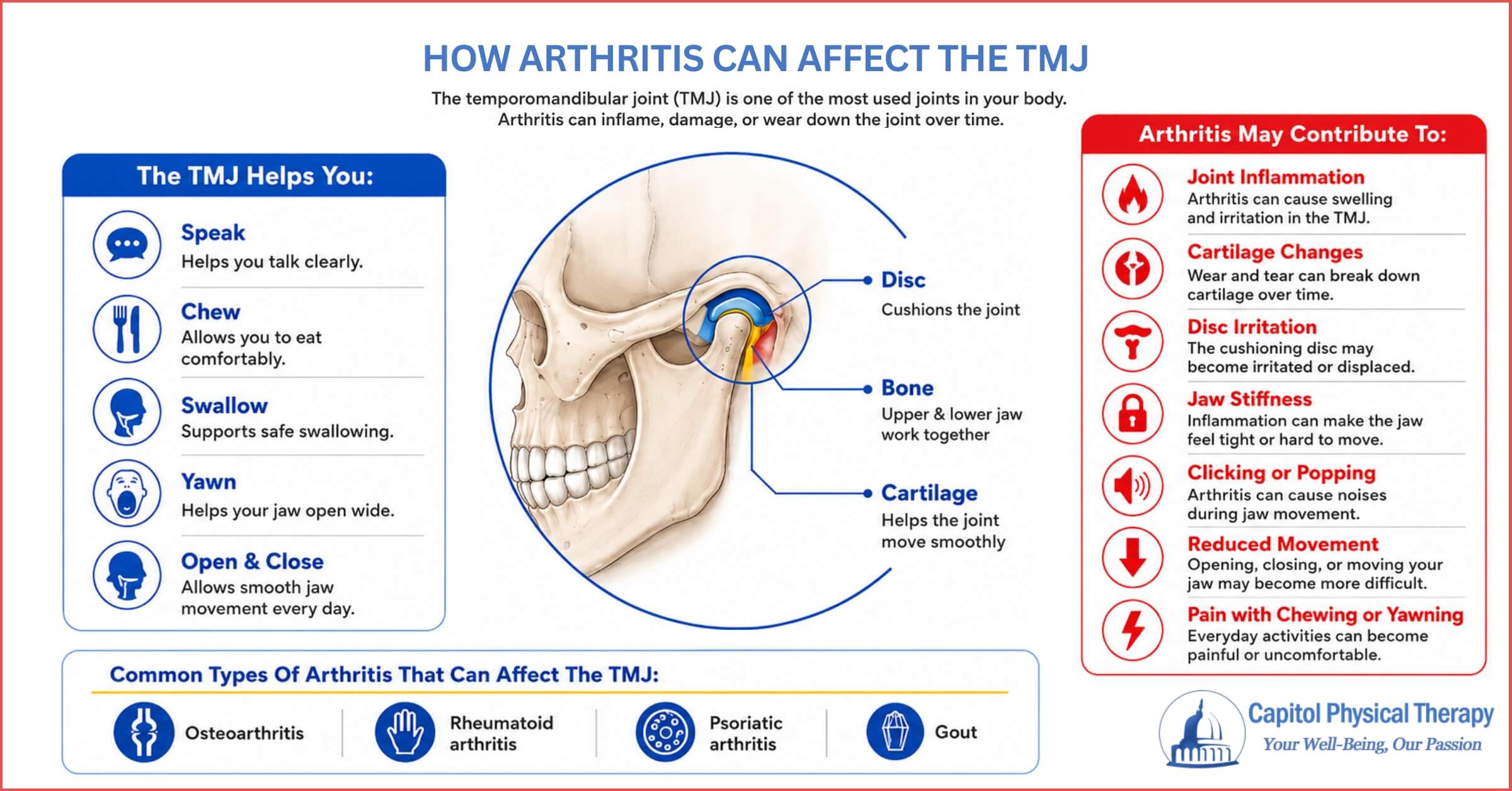
Your TMJ is one of the most frequently used joints in your body.
It helps with chewing, speaking, swallowing, yawning, and other daily movements.
Like other joints, the TMJ contains cartilage and a small disc that help support smooth movement between the bones.
Some forms of arthritis can inflame, damage, or wear down joint tissues over time.
When arthritis affects the TMJ, it may contribute to jaw pain, stiffness, clicking, or reduced movement.
Several types of arthritis can impact your TMJ, including:
- Osteoarthritis
- Rheumatoid arthritis
- Psoriatic arthritis
- Gout
- And others
Stress, trauma, chronic pain, or sleep-related habits may contribute to teeth grinding or jaw clenching.
This habit is known as bruxism, and it can place extra stress on the jaw joints over time.
This added pressure may irritate the jaw joint and surrounding muscles, potentially worsening TMJ symptoms over time.
In some cases, arthritis may affect the jaw joint directly, contributing to TMJ pain, stiffness, or reduced movement.
Researchers are also studying how oral health and the oral microbiome may relate to inflammatory conditions like rheumatoid arthritis.
The oral microbiome refers to the bacteria, viruses, and fungi that naturally live in your mouth.
Research suggests that oral microbiome imbalance may be associated with rheumatoid arthritis, though more research is needed to understand how this may relate to TMJ symptoms.
This keeps the external link but makes the claim more careful.
Some other factors that could contribute to TMJ disorders and jaw arthritis include:
- Physical injuries sustained in a car crash
- Inadequate ligament mechanics
- Hormonal or age-related changes that may affect bone and joint health, including osteoporosis
- Stress, anxiety, or depression
- Congenital differences in jaw development
What Are The Symptoms Of Arthritis-Related TMJ Disorder?
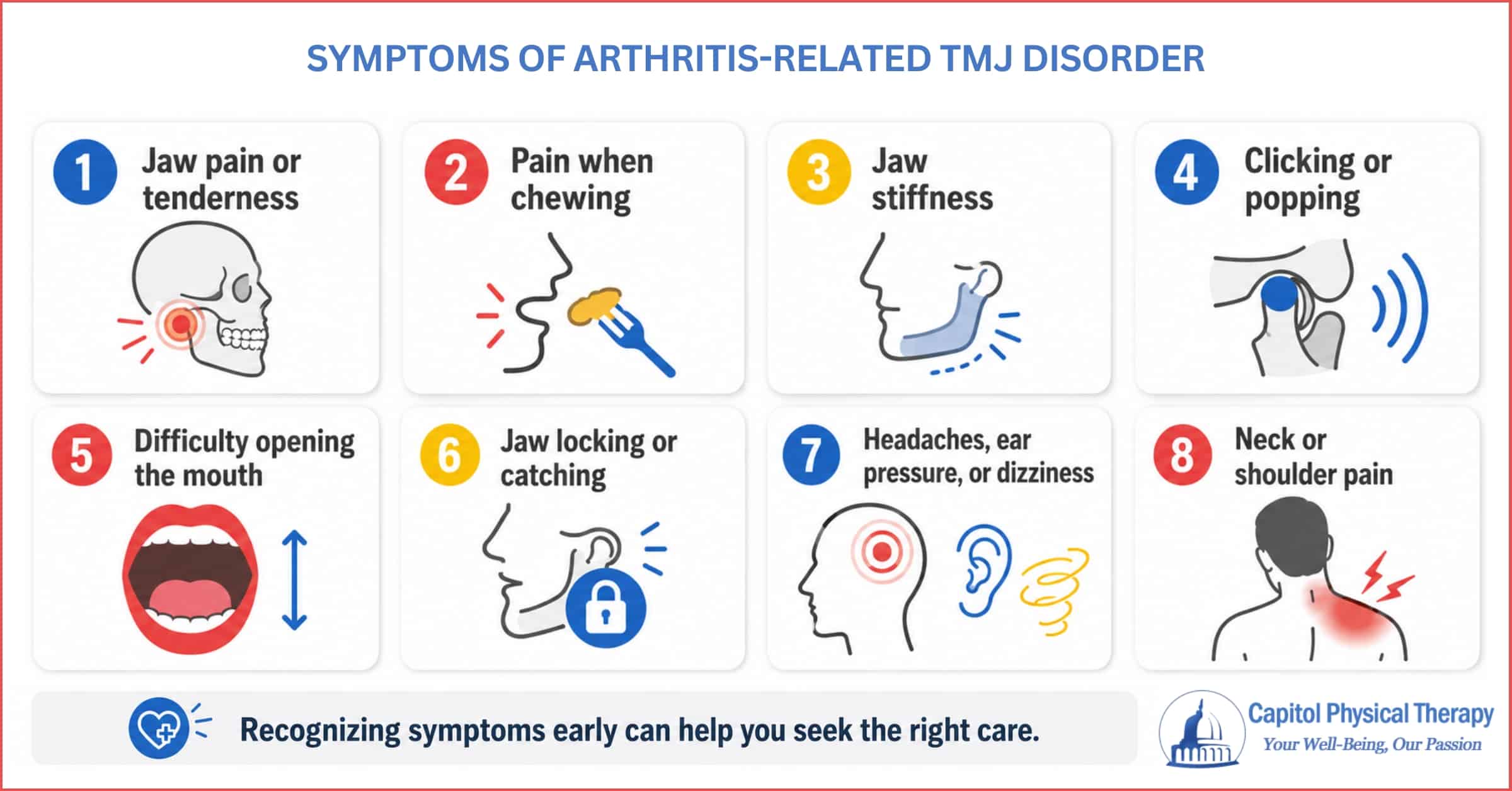
Arthritis-related TMJ symptoms can vary from person to person.
The main sign is pain or tenderness in your jaw.
This might show up on one or both sides of your face.
The pain can also spread to areas surrounding your TMJ.
For example, neck pain, shoulder pain, and inner ear pain can sometimes be connected with arthritis-related TMJ disorder.
This can make chewing painful or uncomfortable.
Some other common symptoms include:
- Frequent headaches
- Eye pain
- Tooth pain
- Jaw stiffness or tenderness
- Difficulty opening your mouth
- Your jaw locking up (not the same thing as “lockjaw”)
- Ringing or pressure in your ears
- Dizziness or difficulty maintaining balance
You might experience these symptoms only during arthritis flares, or more frequently.
Arthritis-related TMJ pain may also overlap with other health concerns.
These may include:
- Poor sleep due to pain
- Lower back pain
- Upper back pain
- Fibromyalgia
Stress, anxiety, and other mental health challenges may also worsen symptoms for some people.
This may happen because some people clench their jaw or grind their teeth without realizing it, especially during sleep.
This added pressure can contribute to wear and irritation in the TMJ over time.
When Should You Seek Help For TMJ Pain?
It’s a good idea to seek professional guidance if jaw pain, stiffness, clicking, or locking lasts more than a few days, keeps coming back, or begins interfering with eating, speaking, yawning, or sleep.
You should also seek care if your jaw gets stuck open or closed, if symptoms are worsening, or if jaw pain is accompanied by significant headaches, neck pain, or ear-related symptoms.
A physical therapist can help evaluate movement, posture, muscle tension, and jaw mechanics, while a dentist or medical provider may also be involved if dental, inflammatory, or structural concerns are suspected.
What Causes Arthritis To Affect The TMJ?
The answer to this question depends on the type of arthritis you have.
The most common type of arthritis is osteoarthritis, which involves gradual changes and wear in joint tissues over time.
This type becomes more common with age.
Because osteoarthritis becomes more common with age, some older adults may also benefit from seniors’ health physical therapy, especially if joint pain, weakness, or balance concerns are affecting daily life.
When gradual joint changes affect the TMJ, osteoarthritis may contribute to jaw stiffness, pain, or reduced movement.
Rheumatoid arthritis works differently.
Rheumatoid arthritis is an autoimmune disorder.
This means your immune system mistakenly attacks healthy tissue instead of only targeting potential threats or infections.
It’s difficult to tell how common TMJ pain is in people with rheumatoid arthritis.
Estimates vary widely, which makes it difficult to give a single reliable number.
When rheumatoid arthritis affects the jaw, symptoms may involve one or both sides, though rheumatoid arthritis often affects joints symmetrically.
There are more than 100 different types of arthritis, and we won’t review all of them here.
However, osteoarthritis and rheumatoid arthritis are two of the most common types discussed in relation to joint pain and inflammation.
How Is Arthritis-Related TMJ Disorder Evaluated?
Evaluating arthritis-related TMJ disorder may not always be straightforward.
Because TMJ disorders are usually evaluated through a combination of symptom history, physical examination, and sometimes imaging, your physical therapist may ask questions such as:
- Where are you feeling pain?
- When does this pain show up?
- Is there anything that makes the pain better or worse?
- Are you experiencing other pain conditions like headaches?
These questions are usually followed by a physical exam.
Your physical therapist will examine your jaw, face, and neck for tenderness, clicking, popping, muscle tension, and movement limitations.
They’ll also watch how you open and close your mouth.
In particular, they’ll look for limited jaw movement or jaw locking.
When jaw motion is restricted, it can be helpful to understand how limited range of motion affects everyday activities and how physical therapy may help restore more comfortable movement.
In some cases, X-rays, MRI, or other imaging may be recommended to assess joint changes, disc position, cartilage loss, or other structural concerns.
Jaw pain can also result from other issues, including neck-related problems, dental concerns, headaches, or muscle tension, so your physical therapist may help identify whether another referral or co-management is needed.
How Can Physical Therapy Help With Arthritis And TMJ Disorders?
If you are experiencing jaw pain, headaches, or neck tension, physical therapy may help improve movement and reduce contributing muscle or joint restrictions.
A full assessment with your physical therapist includes:
- Listening to your symptoms
- Examining your posture
- Checking whether you have difficulty opening and closing your mouth
- Assessing strength in your neck and shoulders
From there, they’ll develop a treatment plan aimed at reducing pain, improving jaw mobility, and supporting more comfortable daily function.
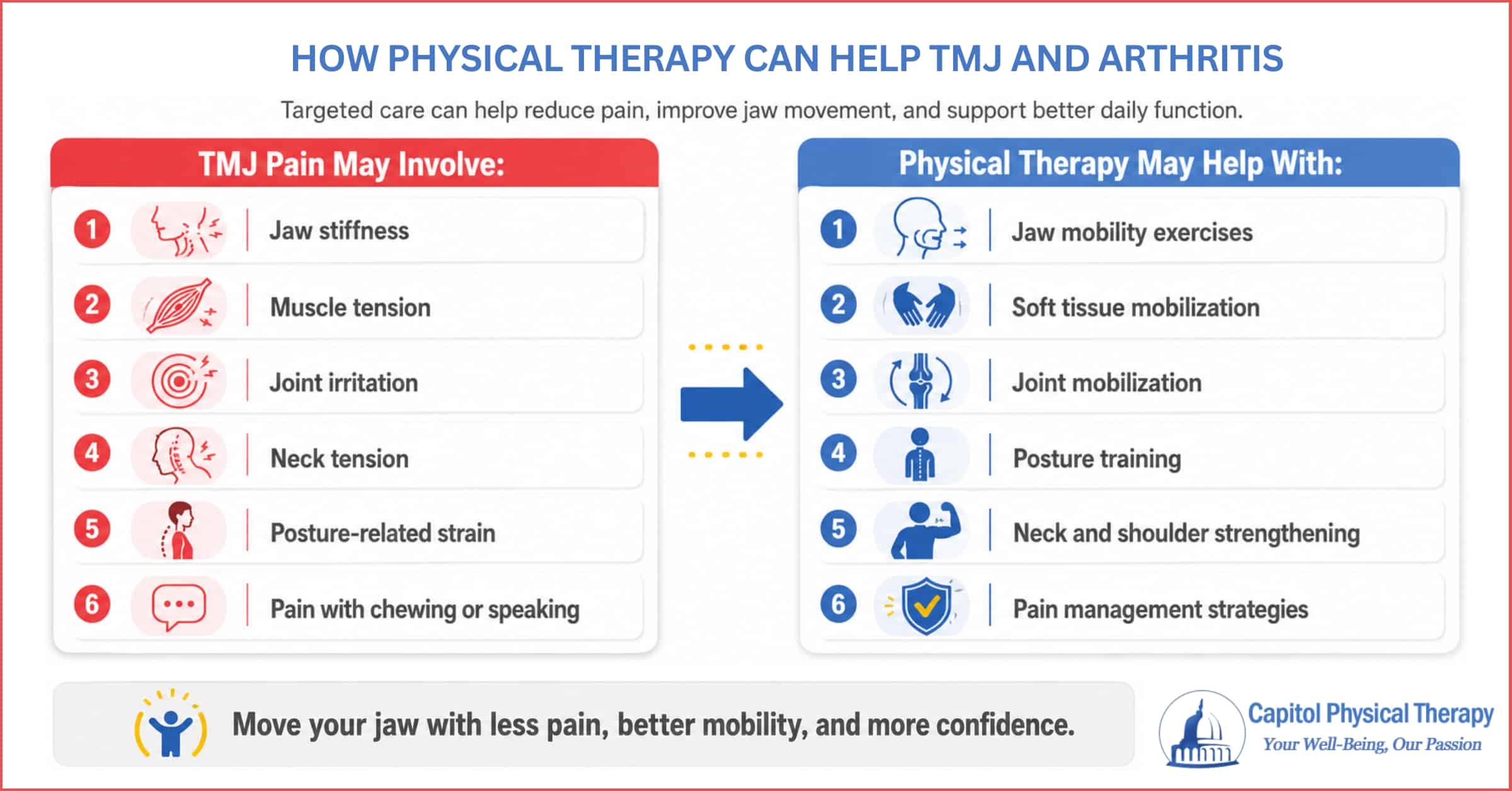
Physical therapy for TMJ disorders and arthritis can include:
- Gentle exercises to stretch and relax your jaw muscles
- Soft tissue mobilization to reduce tension in your face, neck, and shoulders
- Joint mobilization to improve how your jaw moves
- Posture training to take pressure off your jaw
For some patients, dry needling may also be considered when muscle tension in the jaw, neck, or shoulders is contributing to pain.
Because head, neck, and shoulder positioning can influence jaw tension, your treatment plan may also include strategies to improve your posture.
Physical therapy is one conservative treatment option that may be recommended before more invasive approaches.
A personalized treatment plan can help address the specific joint, muscle, posture, and movement factors contributing to your symptoms.
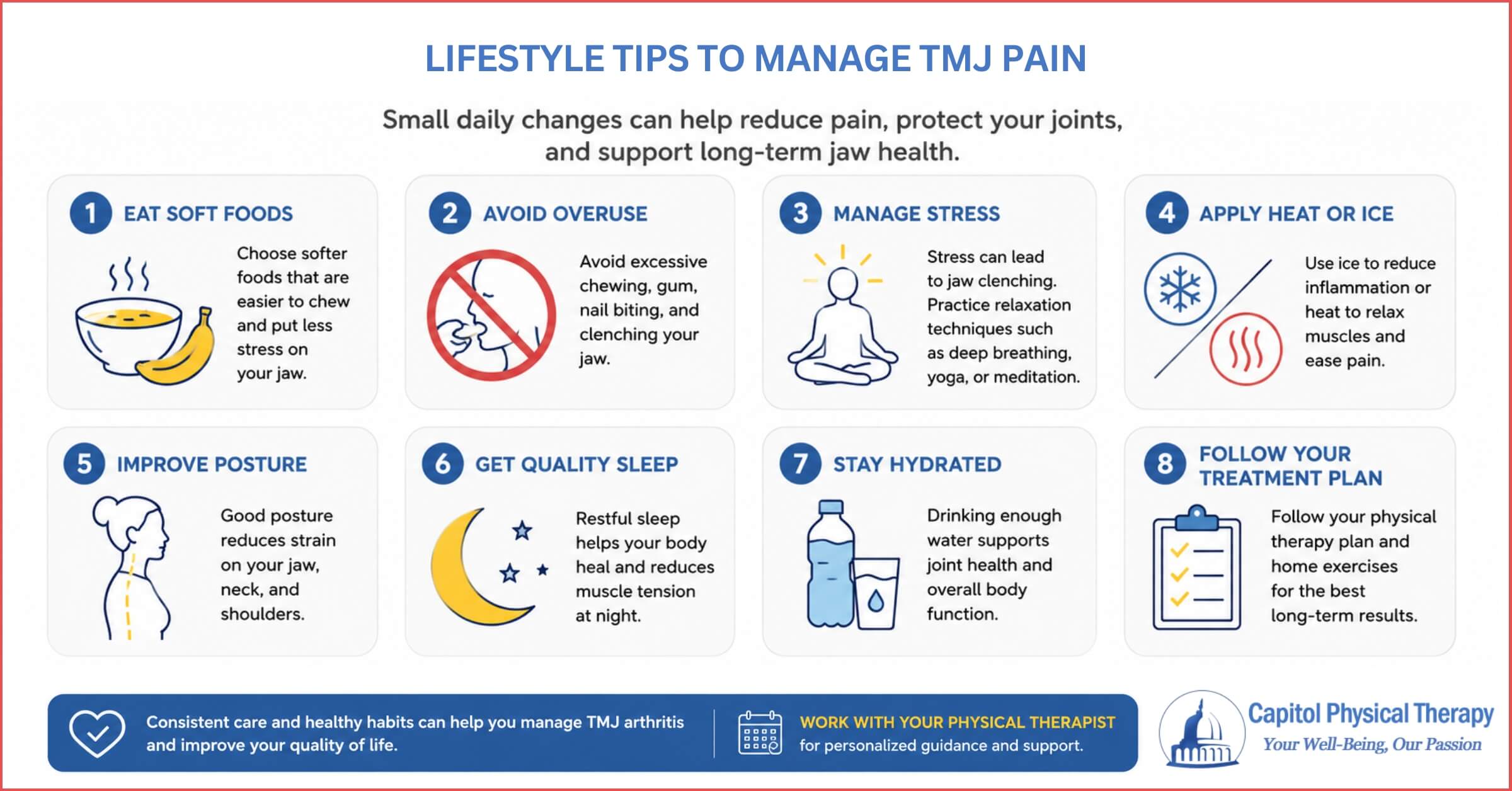
Take The Next Step Toward Lasting Jaw Pain Relief
Jaw pain can make everyday activities like eating, speaking, yawning, and even smiling uncomfortable.
The good news is that many TMJ disorders can improve with conservative treatment, and physical therapy may help reduce pain, improve jaw movement, and support better function without surgery.
At Capitol Physical Therapy, our physical therapists take the time to identify the underlying factors contributing to your symptoms and create a personalized treatment plan tailored to your needs and goals.
Whether your TMJ disorder is related to arthritis, muscle tension, teeth grinding, or another contributing factor, we’re here to help you move more comfortably and get back to your daily routine with confidence.
With two convenient physical therapy clinic locations in the DC area, expert care is always within reach.
Book your appointment with Capitol Physical Therapy today and take the first step toward lasting jaw pain relief.
1100 H St NW Suite 1100,
Washington, DC 20005
- https://g.page/capitolptdc
9560 Pennsylvania Ave. # 202,
Upper Marlboro, MD 20772
- https://goo.gl/maps/zjL4NnnuThRhrcS86
Capitol Physical Therapy offers orthopedic and other pain related solutions, with our versitile team of physical therapists in Washington, DC and Upper Marlboro, MD