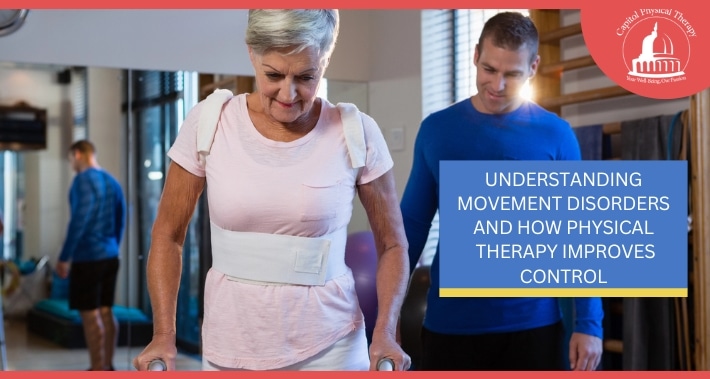
We rely on our ability to move more than we often realize — from walking and reaching to maintaining balance and coordination throughout the day.
These movements depend on your gross motor skills, which involve the large muscles in your arms, legs, and core working together with your nervous system.
But when something disrupts that connection, it can become difficult to control your movements the way you’re used to.
Conditions known as movement disorders can affect how your body moves — sometimes causing stiffness or slowed movement, and other times leading to involuntary or unpredictable motion.
These challenges can impact your daily life, making tasks at work, home, or school more difficult.
The good news is that with the right support, many people can improve their movement, coordination, and overall function.
In this article, we’ll take a closer look at:
- What movement disorders are and how they affect the body
- Common types of movement disorders and their symptoms
- And how physical therapy can help improve mobility, control, and independence
Let’s explore how movement works — and what you can do when it doesn’t feel quite right.
What Are Movement Disorders?
Movement disorders are conditions that result from issues with your nervous system.
These conditions can make it difficult for you to control your movements, either increasing or reducing them.
They can affect voluntary movements, leading to abnormal movements when trying to perform an action.
They can also cause involuntary movements, in which you may not be able to control the movements your body performs.
Movement disorders can impact different physical abilities, including:
- Balance
- Physical strength
- Coordination
- Spatial awareness
- Reaction time
RELATED ARTICLE: What’s Causing Your Poor Balance?
Challenges with your movement and motor skills can also cause mental health difficulties, such as anxiety or low self-esteem.
There are various factors that can contribute to the development of movement disorders, including:
- Genetics
- Deficiency in vitamin B1, B12, or E
- Certain medications
- Misuse of cocaine or alcohol
- Traumatic brain injury
- Family history
- Huntington’s disease
- Wilson’s disease
- Multiple sclerosis
- A thyroid disorder
- And others
However, most of the time, there isn’t a specific known cause.
Regardless of the underlying condition and type of movement disorder you may have, physical therapy can help.
Types Of Movement Disorders
There are numerous types of movement disorders, each with its own symptoms and severity.
Depending on your condition, physical therapy can help address the underlying cause, manage your symptoms, and improve your movement and independence.
Let’s take a closer look at some common types of movement disorders and how they can affect you.
1. Parkinson’s Disease
Parkinson’s disease is a degenerative neurological disease that can significantly affect your movement.
In Parkinson’s disease, dopamine-producing nerve cells in a part of your brain called the substantia nigra begin to break down and die.
This creates a chemical imbalance that affects several of your body’s functions, including movement.
The reason why this occurs isn’t known.
However, contributing factors can include:
- Genetics
- Sex
- Aging
- Exposure to environmental toxins
Symptoms of Parkinson’s disease can include:
- Tremors
- Smaller movements
- Chronic pain
- Muscle rigidity
- Sleep issues
- Poor posture
- Balance problems
- Slowed movements
- Difficulty regulating speech volume
- Difficulty swallowing or making facial expressions
- Lightheadedness
- Decreased sense of smell
- Bursitis
Keep in mind that Parkinson’s affects each person differently and to various degrees.
Physical therapy can help manage your Parkinson’s symptoms and decrease the rate of progression.
Treatment plans for Parkinson’s disease can include:
- Pain management
- Fall prevention therapy
- Gait training
- Fine motor skills therapy
Physical therapy can help you maintain your mobility and quality of life for as long as possible.
2. Ataxia
Ataxia is a condition that affects the brain region responsible for coordination and motor control.
It can make it difficult to control your movements, leading to clumsy arm and leg movements.
It can also cause balance problems and issues with your speech due to difficulty coordinating your mouth muscles.
There are several possible causes of ataxia, including:
- Stroke
- Traumatic brain injury
- Genetics
- Infection
- Degenerative conditions
- Certain medical conditions
- Vitamin deficiencies
- Autoimmune conditions
- Excessive alcohol consumption
RELATED ARTICLE: How Can Physical Therapy Help You Recover From A Stroke?
Physical therapy for ataxia can help manage your symptoms and improve your coordination.
Physical therapy treatments can include:
- Balance training
- Gait training
- Strength training
- Coordination exercises
- Education on assistive devices
3. Dystonia
Dystonia is a condition in which muscles contract involuntarily, causing irregular, twisting, or repetitive movements.
Dystonia can affect your whole body or just one part.
The most common type of dystonia is cervical dystonia.
This causes the neck muscles to contract involuntarily.
It can cause your head to pull, tilt, or shake in different directions.
Symptoms of dystonia may get worse when trying to perform specific movements.
Causes of dystonia can include:
- Genetics
- Stroke
- Traumatic brain injury
- Neurological conditions
- Infections
Physical therapy for dystonia can help reduce and manage symptoms and improve your functional capabilities.
Physical therapy treatments may focus on aspects such as:
- Pain management strategies
- Strength and conditioning exercises
- Stretching and mobility programs
- Postural alignment therapy
4. Chorea
Chorea is a neurological condition that causes quick, involuntary, and irregular movements that keep repeating.
It can cause movements to look fidgety and restless.
Chorea typically affects movements in the:
- Face
- Mouth
- Trunk
- Legs
- Arms
The most common cause of chorea is a genetic condition called Huntington’s disease, which progressively breaks down nerve cells in the brain.
As a result, chorea can lead to uncontrolled movements, as well as cognitive and mental health complications.
Physical therapy for chorea can help improve your function and keep you safer and more independent.
Some physical therapy treatments for chorea can include:
- Fall prevention strategies
- Balance and postural stability programs
- Functional mobility exercises
- Strength and conditioning programs
- Movement control strategies
- Education on lifestyle changes
5. Functional Movement Disorder
Functional movement disorder is a condition that can cause you to perform abnormal movements, even though they’re voluntary.
While similar to other movement disorders, functional movement disorder isn’t caused by a nervous system issue.
It occurs when there are issues with your brain sending and receiving the right signals, affecting how it controls movement.
This can make movement feel out of your control.
Common symptoms of functional movement disorder include:
- Dystonia-like movements
- Tremors
- Shaking
- Jerks or spasms
- Twisting movements
- Muscle weakness
- Gait and balance issues
- Slowed movements
- Fatigue
- Sleep issues
- Pain
- Headaches
RELATED ARTICLE: 10 Different Types of Headaches and What Causes Them
Functional movement disorder is linked to dysfunction in the part of your brain responsible for movement control.
These areas may be overactive or underactive, both at rest and when performing tasks.
Potential risk factors for experiencing functional movement disorder can include:
- Injury
- Stress
- Environmental and lifestyle changes
- Mental health challenges
Multiple factors can contribute to developing symptoms, but regardless of the cause, physical therapy can help.
Physical therapy for functional movement disorder focuses on reducing symptoms and improving function and control.
This can include retraining you in how to perform typical movements, improving your balance and rhythm, and increasing your focus when performing tasks to rebuild your confidence.

How Can Physical Therapy Help With Gross Motor Skills?
If you have any type of movement disorder, gross motor skills physical therapy can help.
Physical therapy for movement disorders aims to manage your symptoms and improve your body’s control and coordination.
Your physical therapist will start by conducting a comprehensive evaluation of your symptoms.
This will help determine the severity of your condition and any underlying causes.
They’ll put together an individualized treatment plan that addresses your unique needs to improve your quality of life.
Gross motor skills physical therapy focuses on improving your strength, balance, coordination, and posture so that you can continue to carry out your daily activities.
Physical therapy strategies and treatments for movement disorders can include:
- Balance and gait training
- Muscle strengthening exercises
- Mobility and flexibility exercises
- Physical therapy for poor posture
- Functional physical therapy
- Fine motor skills physical therapy
- Coordination exercises
- Pain management strategies
- Education on assistive devices and techniques
Ultimately, physical therapy strategies depend on your specific condition, its severity, how it affects your movement, and your goals.
Regardless, if you have a movement disorder, physical therapy can help address your symptoms and increase your mobility and independence.
Book Your Appointment With Our Physical Therapy Clinic Today
Movement disorders can make everyday tasks feel unpredictable and challenging — but with the right support, meaningful progress is possible.
Physical therapy can help improve coordination, restore control, and build the strength and confidence you need to move more freely.
At Capitol Physical Therapy, we take a personalized approach to your care, helping you regain independence and improve your quality of life.
With convenient locations in Washington, DC and Upper Marlboro, MD, expert care is always within reach.
Book your appointment with Capitol Physical Therapy today and take the first step toward more controlled, confident movement.
1100 H St NW Suite 1100,
Washington, DC 20005
- https://g.page/capitolptdc
9560 Pennsylvania Ave. # 202,
Upper Marlboro, MD 20772
- https://goo.gl/maps/zjL4NnnuThRhrcS86
Capitol Physical Therapy offers orthopedic and other pain related solutions, with our versitile team of physical therapists in Washington, DC and Upper Marlboro, MD