If you’ve ever experienced jaw pain, clicking, headaches, or tightness when chewing, it’s easy to assume the problem starts and ends with your jaw joint.
But understanding the muscles behind your TMJ pain can give you a much clearer picture of why your symptoms are happening — and how physical therapy can help.
Your temporomandibular joint, or TMJ, depends on several muscles in your jaw, face, neck, and upper back to work properly.
When those muscles become tight, overworked, irritated, or out of balance, they can contribute to pain, stiffness, headaches, ear discomfort, and difficulty opening or closing your mouth comfortably.
If jaw pain, clicking, headaches, or difficulty opening your mouth are affecting your daily life, TMJ pain physical therapy can help assess the joint, surrounding muscles, posture, and movement patterns that may be contributing to your symptoms.
In this article, we’ll take a closer look at the key muscles involved in TMJ pain, what happens when those muscles become overloaded, why posture matters, and how physical therapy can help relieve discomfort and improve jaw movement.
Let’s explore what may be contributing to your TMJ pain — and what you can do to start finding relief.
Brief Anatomy of Your Jaw
TMJ pain may come from the jaw joint, the muscles that control jaw movement, or a combination of both.
That’s because your temporomandibular joint, or your TMJ, works like a sliding hinge connecting your jawbone to your skull.
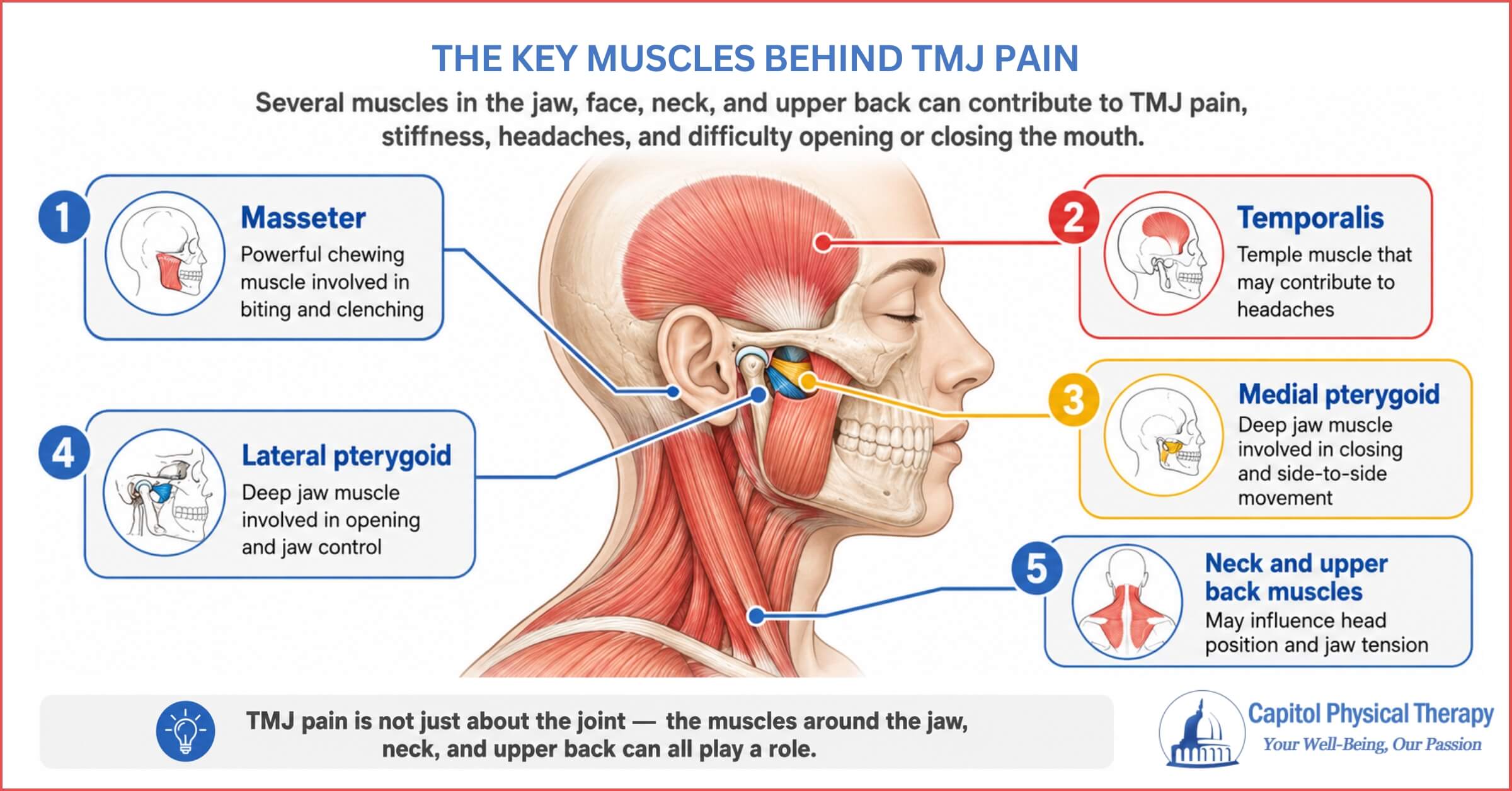
Four main pairs of chewing muscles — the masseter, temporalis, medial pterygoid, and lateral pterygoid — help control jaw movement.
Muscles in the neck and upper back may also influence head position, muscle tension, and how comfortably your jaw moves.
Understanding which muscles are involved and how they contribute to symptoms is the first step toward effective treatment.
For a broader overview of jaw clicking, locking, pain, and treatment options, you can also read our guide to TMJ disorders and physical therapy for jaw pain.
The Key Muscles Involved in TMJ Pain
According to NIH’s National Institute of Dental and Craniofacial Research, temporomandibular disorders affect about 5% of adults in the United States.
TMDs are considered the second most common musculoskeletal condition after chronic lower back pain.
A 2024 meta-analysis by Zieliński, Pająk-Zielińska, and Ginszt estimated a prevalence of 34% worldwide and 26% in North America, although prevalence estimates can vary depending on the population and diagnostic criteria used.
Let’s take a look at some of the key muscles that may be involved in TMJ pain.
These are among the muscles your physical therapist may assess when determining what is contributing to your symptoms.
1. The Masseter
The masseter is the large, powerful chewing muscle on both sides of your jaw.
The masseter contracts when you bite or clench your teeth and may be assessed during physical therapy when muscle tension is contributing to your symptoms.
Frequent clenching or teeth grinding can overload this muscle and may contribute to jaw pain, tenderness, or fatigue.
2. The Temporalis
The temporalis is a fan-shaped muscle running along your temple.
When it is overworked or tense, it can contribute to jaw pain, temple headaches, and a feeling of tightness along the side of the head.
Your physical therapist may assess the temporalis for tenderness, tightness, or referred pain when evaluating your symptoms.
3. The Pterygoid Muscles
The medial and lateral pterygoids are located deeper within the jaw.
Together, they help control opening, closing, forward movement, and side-to-side movement of the jaw.
When jaw tightness limits how far you can open your mouth, it can be helpful to understand how limited range of motion affects everyday movement and how physical therapy may help.
4. The Neck and Upper Back Muscles
You might wonder what your neck and upper back have to do with TMJ pain.
The positioning and movement of these areas can influence tension around the jaw.
The sternocleidomastoid, upper trapezius, and suboccipital muscles can influence head and neck positioning and may contribute to tension or discomfort around the jaw.
As a result, TMJ pain may occur alongside neck pain, upper back pain, and headaches.
For some people, upper-neck tension occurs alongside TMJ pain and may contribute to headaches or discomfort felt around the ear.
Prolonged desk work may also contribute to stiffness in the neck and shoulders, which can increase tension around the jaw for some people.
If desk posture is contributing to neck, shoulder, or jaw tension, ergonomics-focused physical therapy can help you adjust your workstation and movement habits to reduce strain.
Physical therapy may address the jaw, neck, shoulders, and upper back together when these areas appear to be contributing to your symptoms.
What Happens When These Muscles Become Overloaded
The exact cause of TMJ pain is not always clear, and several contributing factors may be involved at the same time.
When the jaw muscles remain tense or overworked, they may develop tender or sensitive areas and refer pain into the face, ears, temples, or neck.
Persistent clenching, grinding, or muscle tension may also place additional stress on the jaw joint and make symptoms more difficult to manage.
Habits such as teeth clenching, teeth grinding, frequent gum chewing, and nail biting may contribute to TMJ symptoms.
Chronic stress may also increase jaw clenching or persistent muscle tension, making symptoms more difficult to manage.
When jaw pain becomes long-lasting, it may also overlap with broader chronic pain patterns that affect how your body responds to tension and discomfort.
TMJ symptoms may also occur alongside conditions such as fibromyalgia or osteoarthritis, or following an injury to the jaw.
If arthritis may be contributing to your jaw pain, you can also learn more about the connection between TMJ disorders and arthritis.
Why Is Posture Important In TMJ Pain?
Just as your neck and upper back play a bigger role in TMJ than you might think, so too does posture.
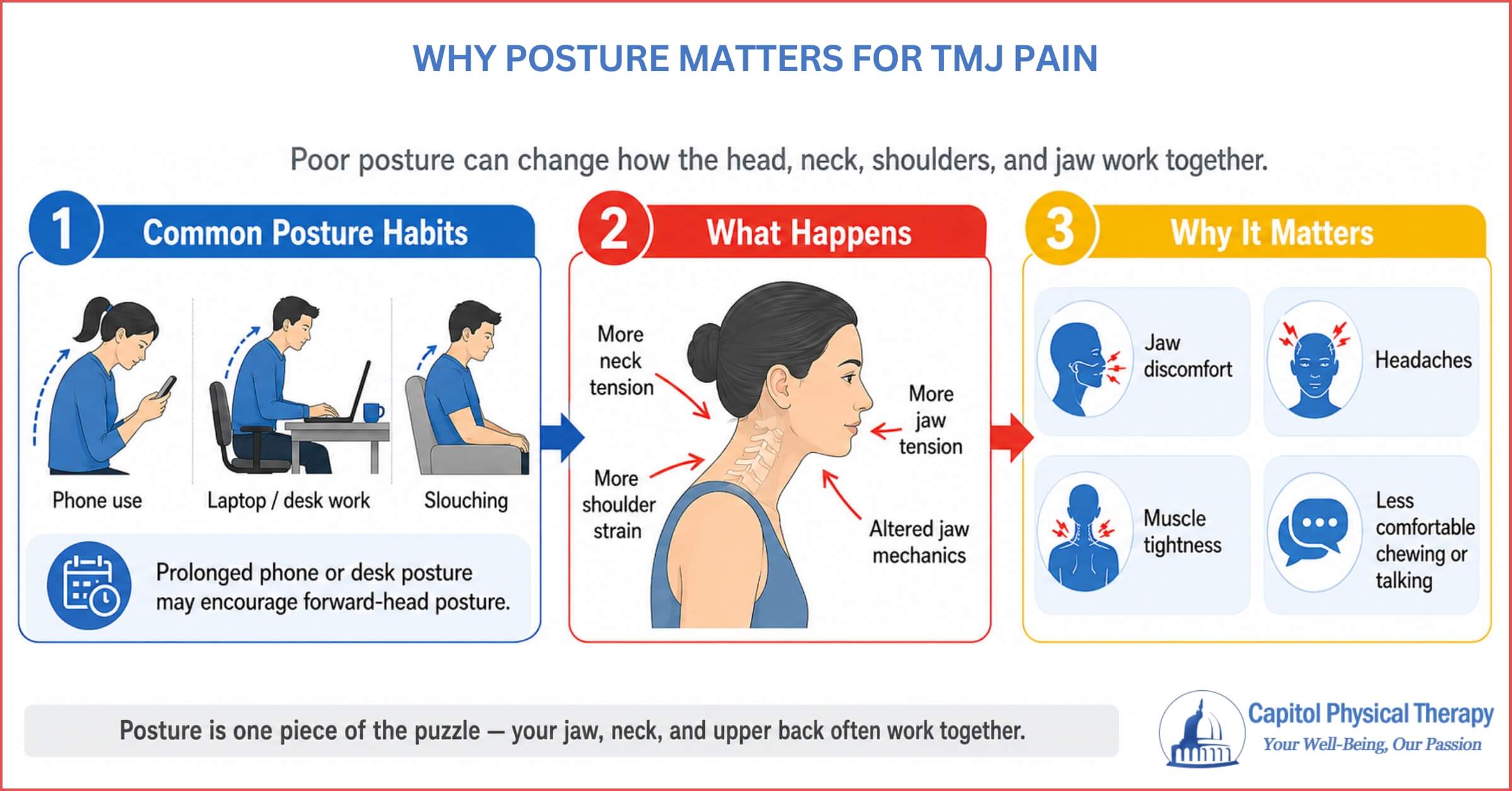
Forward-head posture, which is common during prolonged desk work or phone use, can change the way the head, neck, and jaw muscles work together.
This same posture pattern is also commonly discussed in relation to text neck syndrome, especially when phone or computer use contributes to neck, shoulder, and jaw tension.
For some people, this may increase muscular demand around the neck and jaw and contribute to ongoing tension.
When posture is contributing to symptoms, physical therapy for poor posture may be included as part of a broader TMJ treatment plan.
How Physical Therapy Targets the Muscles Behind TMJ Pain
Physical therapy is one conservative treatment option for addressing muscle and movement factors that may contribute to TMJ pain.
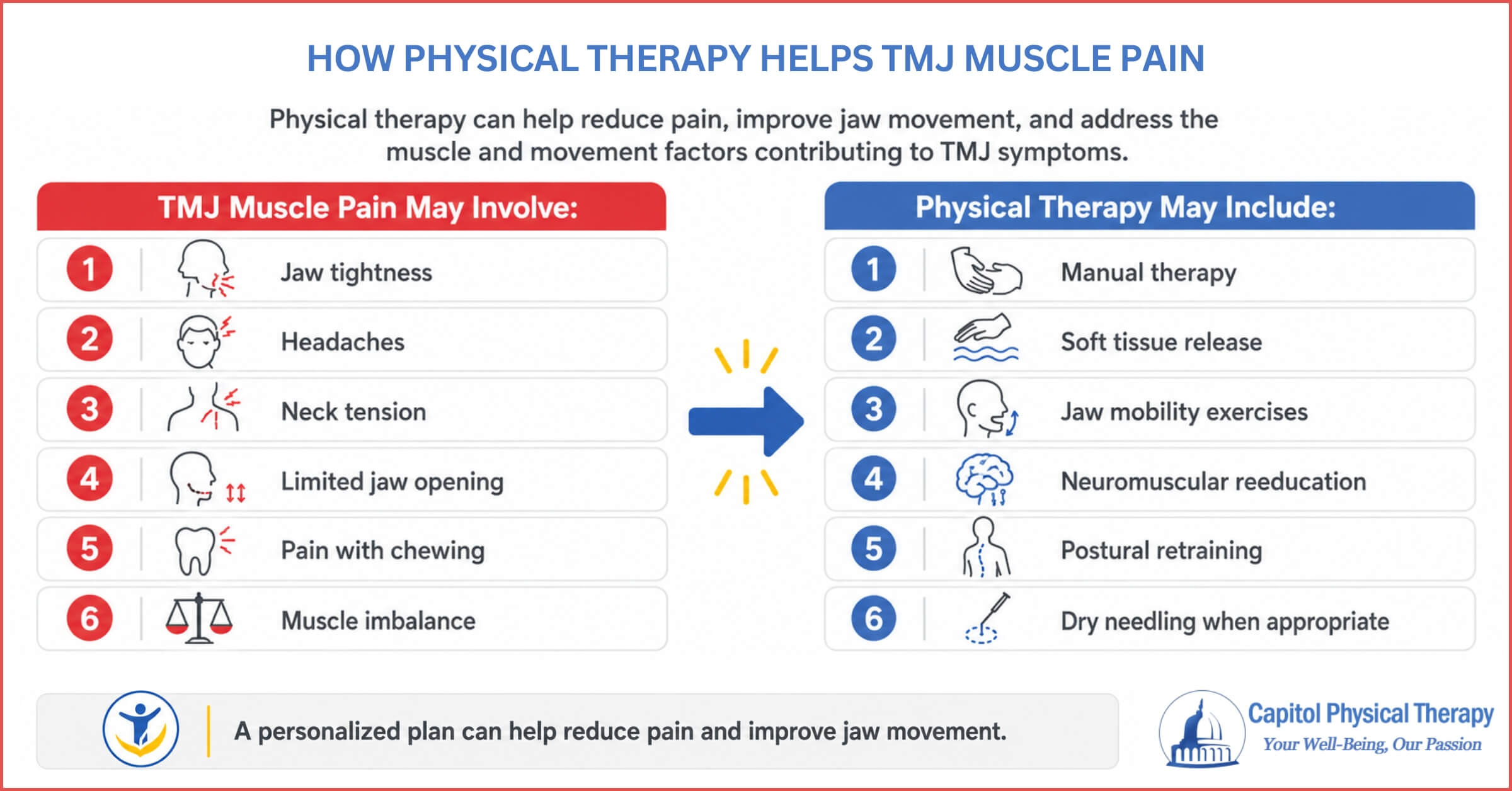
A physical therapist may use manual therapy, exercise, postural retraining, and other techniques to reduce tension, improve movement, and help with pain management.
Common treatment approaches may include:
1. Manual Therapy and Soft Tissue Release
Manual therapy and soft tissue release refer to hands-on techniques applied to the jaw, face, neck, and upper back.
These can include soft-tissue manipulation, myofascial release, and trigger-point work.
When clinically appropriate, a specially trained physical therapist may also use intraoral manual techniques, with your consent, to address muscles that are difficult to reach from outside the mouth.
These techniques may help reduce muscle tightness, improve mobility, and ease discomfort around the jaw.
2. Therapeutic Exercise
Your physical therapist may also recommend targeted mobility, coordination, stretching, or strengthening exercises based on your specific symptoms.
For some patients, neuromuscular reeducation may also help retrain how the jaw, neck, and upper back muscles coordinate during daily movement.
Some examples of exercises that they might recommend, depending on the source of your tension, include:
- Chin tucks
- Tongue lifts
- Jaw side-to-side slides
- Resisted mouth closing
- Resisted mouth opening
These exercises should be selected and progressed by your physical therapist, since an exercise that helps one type of TMD may aggravate another.
3. Postural Retraining
When head, neck, or shoulder positioning is contributing to your symptoms, your treatment plan may include postural exercises such as:
- Strengthening your deep neck flexors
- Strengthening your upper back
- Correcting forward-head posture
These exercises may help reduce unnecessary muscular tension and improve how the jaw, neck, and upper back work together.
4. Dry Needling
Dry needling may also help address myofascial pain and muscle tension in the masseter, temporalis, and surrounding muscles.
A 2025 review by Khayamzadeh, Razmara, and Tavassoli reported that dry needling, alone or alongside other therapies, may help reduce pain and improve function in people with TMJ disorders.
At Capitol Physical Therapy, dry needling physical therapy may be used when muscle tension in the jaw, neck, or shoulders is contributing to TMJ pain.
Dry needling involves inserting thin, sterile needles into selected muscle or connective-tissue areas to address myofascial pain and muscle tension.
For some patients, dry needling may be considered alongside manual therapy, exercise, and other treatments as part of an individualized plan.
Find Lasting Relief From TMJ Pain
TMJ pain can interfere with daily life, but conservative treatment may help you manage symptoms and move more comfortably.
With the right treatment plan, many people can reduce pain, improve jaw movement, and return to eating and speaking more comfortably.
At Capitol Physical Therapy, our experienced physical therapists take a whole-body approach to TMJ treatment, addressing not only your jaw but also the muscles in your neck, shoulders, and upper back that may be contributing to your symptoms.
We’ll create a personalized treatment plan designed to manage pain, improve function, and reduce factors that may contribute to recurring symptoms.
With two convenient physical therapy clinic locations in the DC area — Washington, DC, and Upper Marlboro, MD — expert care is always within reach.
Choose the location that’s most convenient for you and let our team help you get back to living with greater comfort and confidence.
Book your appointment with Capitol Physical Therapy today and take the first step toward lasting relief from TMJ pain.
1100 H St NW Suite 1100,
Washington, DC 20005
- https://g.page/capitolptdc
9560 Pennsylvania Ave. # 202,
Upper Marlboro, MD 20772
- https://goo.gl/maps/zjL4NnnuThRhrcS86
Capitol Physical Therapy offers orthopedic and other pain related solutions, with our versitile team of physical therapists in Washington, DC and Upper Marlboro, MD