
Wrist pain has a way of making even simple daily tasks feel frustrating.
Typing at your computer, cooking dinner, lifting objects, or even holding your phone can become uncomfortable when the tendons in your wrist become irritated and inflamed.
Wrist tendinitis is a common repetitive strain injury that can develop gradually over time or appear after increased stress on your wrist.
Left untreated, the pain and stiffness can worsen and start interfering with your ability to work, exercise, or enjoy everyday activities.
The good news is that early treatment and the right movement strategies can make a big difference.
In this article, we’ll take a closer look at:
- What wrist tendinitis is and what causes it
- Common signs and symptoms to watch for
- How it differs from conditions like carpal tunnel syndrome
- And how physical therapy can help reduce pain, restore strength, and improve mobility
Let’s explore what might be causing your wrist discomfort — and what you can do to start feeling better.
What Is Tendinitis In Your Wrists?
The term “tendinitis” combines “tendon” with the suffix “-itis,” which refers to inflammation.It’s suffix, itis refers to the presence of swelling.
Wrist tendinitis is a condition involving irritation and inflammation of the tendons in the wrist.
Tendons are rope-like structures that connect your muscles to their corresponding bone.
Several important tendons pass through the wrist and help control movement of the hand and fingers.
Some of these include the:
- Flexor carpi radialis
- Flexor carpi ulnaris
- Palmaris longus tendon
- Extensor carpi radialis brevis
- Extensor carpi radialis longus
- Extensor carpi ulnaris
These tendons all play a crucial role in connecting the muscles in your forearm to your wrist, hand, and finger bones.
Tendonitis can also occur in various other parts of your body, including your:
What Causes Wrist Tendinitis?
Inflammation in your tendons is the primary cause of wrist tendinitis.
Various factors may contribute to the development of this inflammation.
Wrist tendinitis is considered to be a repetitive strain injury.
According to the Center for Orthopedic Surgery and Sports Medicine, the most common factor is overuse, such as during prolonged repetitive motions.
Poor mechanics during repetitive activities can increase stress on the wrist and contribute to tendon irritation.
Injury can also play a role.
Wrist tendinitis specifically refers to the early stages of tendon inflammation and irritation.
As tendon irritation becomes more chronic over time, it may progress into tendinopathy, a condition involving tendon degeneration and impaired healing capacity.
If wrist pain is interfering with work, exercise, or daily activities, early treatment can help prevent symptoms from becoming more persistent.
There are a few types of tendinitis in your wrist that can affect different tendons.
Tenosynovitis describes an irritation that develops when your synovial sheath thickens and restricts your tendons.
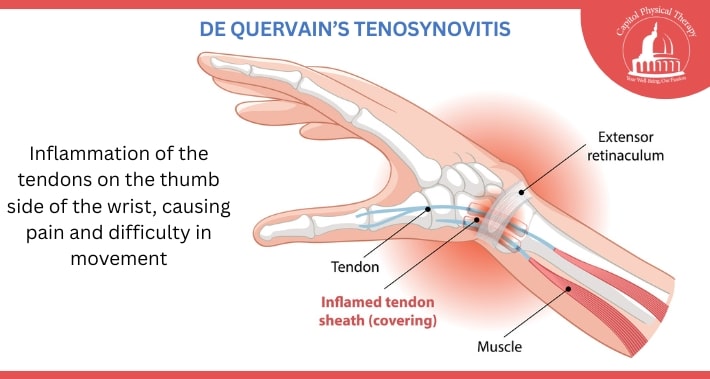
De Quervain’s tendinitis describes a tendinitis that can develop on the side of your wrist near your thumb.
How Do You Know If You Have Wrist Tendinitis?
Inflammation of the tendons in your wrist is the primary symptom of wrist tendinitis.
This feels like pain in your wrist which can radiate up into your elbow.
If it’s De Quervain’s tendinitis, you’ll notice that the pain is located in the thumb side of your wrist.
Pain may only manifest when your wrist is under strain or under pressure.
Without treatment or activity modification, symptoms often worsen over time.
Some other signs to watch out for are:
- Wrist stiffness
- Decreased wrist mobility
- Visible swelling and inflammation
- Tender hand, wrist or forearm muscles
RELATED ARTICLE: What’s The Difference Between Sprains Vs Strains
Can Wrist Tendinitis Go Away On Its Own?
Mild cases of wrist tendinitis may improve with rest and temporary activity modification.
However, continuing repetitive movements or ignoring symptoms can place ongoing stress on the tendons and potentially worsen inflammation over time.
Without proper treatment, wrist tendinitis can become more persistent and begin interfering with daily activities like typing, gripping, lifting, or exercising.
Early physical therapy can help reduce irritation, improve movement mechanics, and address the underlying factors contributing to your symptoms before the condition progresses further.
What’s The Difference Between Tendinitis And Carpal Tunnel Syndrome?
Tendinitis and carpal tunnel syndrome are very different conditions that share some symptoms.
These conditions typically have distinct causes.
For instance, inflammation is the root cause of tendinitis.
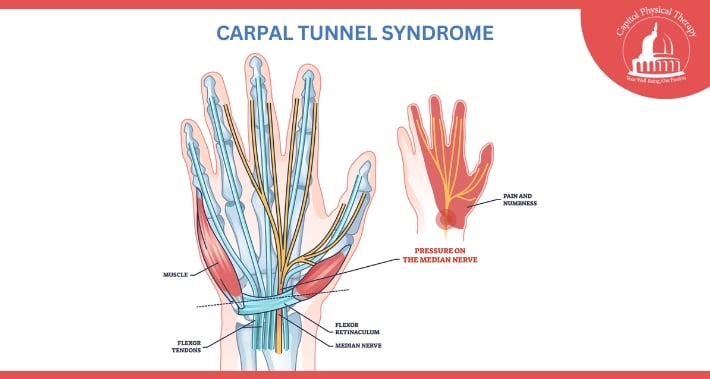
Carpal tunnel syndrome occurs when the median nerve becomes compressed as it passes through the wrist.
This can result in numbness or tingling on the palm side of your wrist in your thumb, index, or middle fingers.
These are the areas served by the median nerve.
If you feel numbness in these areas but also your forearm, the cause may actually be in your neck where the nerve root is rather than at the wrist.
If the numbness and tingling is in the pinky and ring finger, you might be dealing with compression or a condition of the ulnar nerve instead.
Pain along the tendons of the wrist — especially with movement or gripping activities — may be more consistent with wrist tendinitis.
A physical therapist can help determine whether your symptoms are related to wrist tendinitis, carpal tunnel syndrome, nerve compression, or another condition.
How Physical Therapy Can Help With Wrist Tendinitis
Physical therapy can be an excellent treatment for wrist tendinitis.
Your physical therapist will first perform an evaluation in order to assess which treatment strategy will be the most effective for your particular case.
Keep reading to learn more about what this process could look like.
1. Empowering You With Knowledge
Patient education is an important first step.
Your physical therapist will empower you with knowledge to help you get back to the activities you love safely.
To do this, they will teach you strategies to reduce your risk of injury in your daily activities.
For example, it’s good practice to take frequent breaks from repetitive tasks like typing.
Another example is making sure to keep your wrist in a neutral position during repetitive tasks.
RELATED ARTICLE: Reduce The Risk Of Falls & Learn Fall Recovery In Seniors
2. Pain Management
After education and activity modification, the next focus is pain management.
Your physical therapist will help you to identify and adapt movements that cause pain.
Your therapist will correct any abnormal postures present in your day-to-day activities in order to reduce stress on your wrist.
They may even recommend icing your wrist during rest or using a wrist brace to restrict movement so that your wrist can heal.
Your physical therapist might also suggest additional pain management measures, such as dry needling.
RELATED ARTICLE: Physical Therapy Vs Opioids For Chronic Pain Relief
3. Exercises To Restore Range Of Motion
As pain and inflammation improve, your therapist will begin restoring mobility and range of motion through targeted exercises.
The type of exercises will depend on the location and severity of your symptoms.
RELATED ARTICLE: Understanding Limited Range Of Motion: Causes, Conditions, And How Physical Therapy Can Help

4. Exercises To Restore Strength
Your therapist will also guide you through strengthening exercises for your wrist, forearm, and surrounding muscles.
Like your range of motion exercises, the exact type will focus on your particular area of weakness.
Depending on how long it took before you sought treatment for your tendinitis, the condition can also weaken your elbow, shoulder, and arm.
This weakness can then contribute to the movement dysfunction that potentially caused or worsened your tendinitis.
That’s why you need to diligently follow your plan and stick to treatment to restore strength to affected areas.
RELATED ARTICLE: Using Physical Therapy To Rebuild Strength
5. Ergonomic Adjustments
Finally, in order to prevent reinjury, your therapist will share ergonomic adjustments you can make to support your wrist.
This will depend on what your day-to-day looks like.
Proper wrist mechanics are equally important for typing on a computer or swinging a racquet.
RELATED ARTICLE: How To Set Up An Ergonomic Desk To Prevent Workplace Injury
Book Your Appointment With Our Physical Therapy Clinic Today
Wrist tendinitis can make even simple tasks feel frustrating and uncomfortable — but early treatment can help you avoid long-term complications and get back to using your hands with confidence.
Physical therapy can reduce pain and inflammation, restore mobility and strength, and help you correct the movement patterns that may be contributing to your symptoms.
At Capitol Physical Therapy, we create personalized treatment plans designed around your daily activities, goals, and recovery needs so you can return to work, exercise, and everyday life more comfortably.
With two convenient locations in the DC area, expert care is always within reach.
Book your appointment with Capitol Physical Therapy today and take the first step toward stronger, pain-free wrist movement.
1100 H St NW Suite 1100,
Washington, DC 20005
- https://g.page/capitolptdc
9560 Pennsylvania Ave. # 202,
Upper Marlboro, MD 20772
- https://goo.gl/maps/zjL4NnnuThRhrcS86
Capitol Physical Therapy offers orthopedic and other pain related solutions, with our versitile team of physical therapists in Washington, DC and Upper Marlboro, MD